Adventures of a teenage author...

This is Marta, author of the Darkwoods series and of Marta's Blog. I created this blog specifically for blogging about my 2015 study abroad adventures in Europe, but it's becoming the blog for all my travels. I hope you enjoy all the pictures and stories!

Friday, June 14, 2019

Tokyo, Day 3 - Imperial Palace

The Imperial Palace in Tokyo is huge. It takes up most of the area of Chiyoda, which, as I recall, is about the middle of Tokyo. 


Getting to the Imperial Gardens isn't easy, since it's a lengthy walk from the nearest subway stop. Furthermore, they aren't open on normal days. The first day I walked there, I got there and found they were closed. 

Still saw some birds in the moat on the outside, though:


Anyway, the next day I went there with two friends, and we spent the morning walking around the Imperial Palace. 

It turns out that they have a phone app that you can download and it will serve as your personal tour guide. It knows your location, so when you get near something important, it will send you a notification and you can listen to what the tour tells you.

I have that app on my phone right now, so any information you see here, assume it comes from that app unless I say otherwise. 

During the Tokugawa Shogunate, the Shoguns (highest ranking military lord) lived in the castle, and they were the ones who built most of it. After the Shogunate disbanded, Emperor Meiji moved in. He renamed the city from Edo to Tokyo, and made the Edo Palace the Imperial Palace. 

There used to be a huge castle, but it was destroyed. Now in its place are the East Gardens, which is where we wandered around. 

Unfortunately, you can't tour all of the Imperial Palace. The only parts that are normally open to the public are the East Gardens, but those alone could take all day if you were so inclined. 

The gardens were originally built without disrupting the natural characteristics of the ground. The slopes, gullies, ponds, etc., are all natural with improvements to make them more picturesque. 

First, we entered through the Ote-mon Gate, which is actually two gates. The first gate, shown below, is very small:


After the first gate, there is a picturesque little square inside. The second gate is to your right as you go in:


Sigh... can't escape the skyscrapers
The second gate being to the right meant that if an army got through the first gate by charging, they lost all the momentum of their charge when they had to turn right. Furthermore, I don't think the square is big enough to get more momentum for another charge. 


On top of the second gate is a building where defenders could shoot down on invaders. 

The second gate was destroyed in an air raid (get used to seeing that), but it was rebuilt after. 

Inside the Ote-mon Gate

This next building is inside yet another gate. It's called the Doshin-bansho, and it roughly means a guardhouse. Lower-ranking Samurai (Doshin) would say in here to help protect the gate.


After the Doshin-bansho, we saw some of these impressive stone walls (for more gates):


I sincerely wonder how they were able to move rocks that large.

This next building is the Hyaku-nin-bansho, a guardhouse for higher-ranking Samurai. It is in between two gates, and the inner gate leads to the main part of the castle. It goes from north to south, and there were four groups of Samurai, 120 each, that took turns guarding the palace 24 hours a day. 


The gate that goes to the Hon-maru, the heart of the castle

Don't remember what this is, but it's huge!

Pretty pine trees! Inside the Hon-maru now. 

Once we were inside the gardens, we spent a lot of time wandering around and looking at absolutely beautiful gardening.


So many trees! There really isn't a lush forest like this in Shenyang, so I was deliriously happy. 

I'm going to just have a bunch of pictures of the lovely gardens now, because they're beautiful and don't need too much explanation. (Also because I'd like my readers to get some surprises whenever they get there!)


Those pictures were all in the lower levels of the gardens. After seeing these, we went up to the higher levels of the gardens. 

First, we had to go up the Shiomi-zka, a slope that you could supposedly see part of Tokyo Bay from. This slope goes up from the Hon-maru (the main part of the gardens) tot he Ninomaru (the second compound).


This is the Hakucho-bori Moat, the only moat still inside the palace. There used to be many inside the palace!

Looking down the Shiomi-zaka


This next building is the Fujimi-yagura. The name means "Fuji-viewing tower", since you could see Fuji from this tower before the high-rises were all built. (To me, this tower just epitomizes Tokyo. Once upon a time, you could see Fuji from a structure rich in history, and now you can't because of recent progress. Of course, given how recently Japan was all but destroyed in World War II, I don't think anyone is going to be keen to take down those signs of extreme growth and vastly-improved quality of life.)


This is, after all, the Land of the Rising Sun. I had to get a picture with sun flare!


This is the tea gardens! Tea was from China first, and brought to Japan more than 1,000 years ago. I've been told that Japanese tea culture is a rival to Chinese tea culture (although my teahouse friend from China would probably disagree!)

The next pictures are all from inside the Fujimi-tamon Defense House. Did anyone notice the word "Fuji" in the name? That indicates that, once upon a time, people inside the house could see Fuji from the windows.

Notice anything interesting about these pictures? Specifically, on the floor?


They require visitors to take off their shoes inside.


This used to be a moat. Defenders could fire arrows or bullets through the slits. 


This is the Ishi-muro, which means "stone room". No one knows what it's for!

This is the Bamboo Garden

This is part of the Cherry Blossom Island (because you can't go to Japan without seeing some cherry trees). It's the wrong season for the blossoms, obviously. There are about 30 types of cherries in the gardens!

The last is the foundation of the Tenshu-dai, which used to be the largest tower in the palace. Unfortunately, it was burned down in a fire in 1657, and it was never rebuilt.


That short building in the foreground is the music house. 


And that was a wrap! We walked through a few more gardens on the way out, but that was the end of our tour of the palace. It's a beautiful place with so much nature and artistry that I would happily go back! Definitely a must-see in Tokyo. 


The outer moat

The exit

Walking away from the palace


Thursday, April 18, 2019

Tokyo, Day 2 - Tokyo Station

I went to the Sensoji Shrine by myself, but a couple of hours after that, my wonderful, genius, patient, pleasant, sweet, long-suffering, brilliant chef of a roommate (she reads this blog) arrived in Tokyo. As part of the afternoon, we decided to head to Tokyo Station.

Something really neat about the subway stations in Japan is that around each subway stop is a variety of shopping and eating places. The one nearby our hostel was minimal, but apparently the grandest one is Tokyo Station.

There is an entire two rows dedicated to anime stores, and since I've gotten into that a little bit, I had a lot of fun looking at those. We also wandered around the rest of the station, too!

First, this is the escalator down into the subway station:


Next, pictures from the anime section!

This is the Miyazaki section
 And............ everyone knows this next section!

Gotta catch 'em all!


I don't know if I mentioned this, but we were there at the beginning of October. Apparently Japan really gets into Halloween (at least the touristy parts do), so we had fun seeing Pokemon in Halloween costumes!


Pikachu in an Eevee costume!

Look at all the costumes! I especially love the Sableye dressed up as a Litwick!

I love Pokemon Go, but I don't know this team...

So cute!!

After that, we went wandering around the subway station, and we found a candy store. Entirely to my delight, we got to see a guy making hard candy!


After that, we went to dinner. After dinner, we went home, but not before I saw this beautiful room:


Monday, April 15, 2019

Tokyo Day 2 - Sensoji Temple

Finally made it to Tokyo, Day 2!

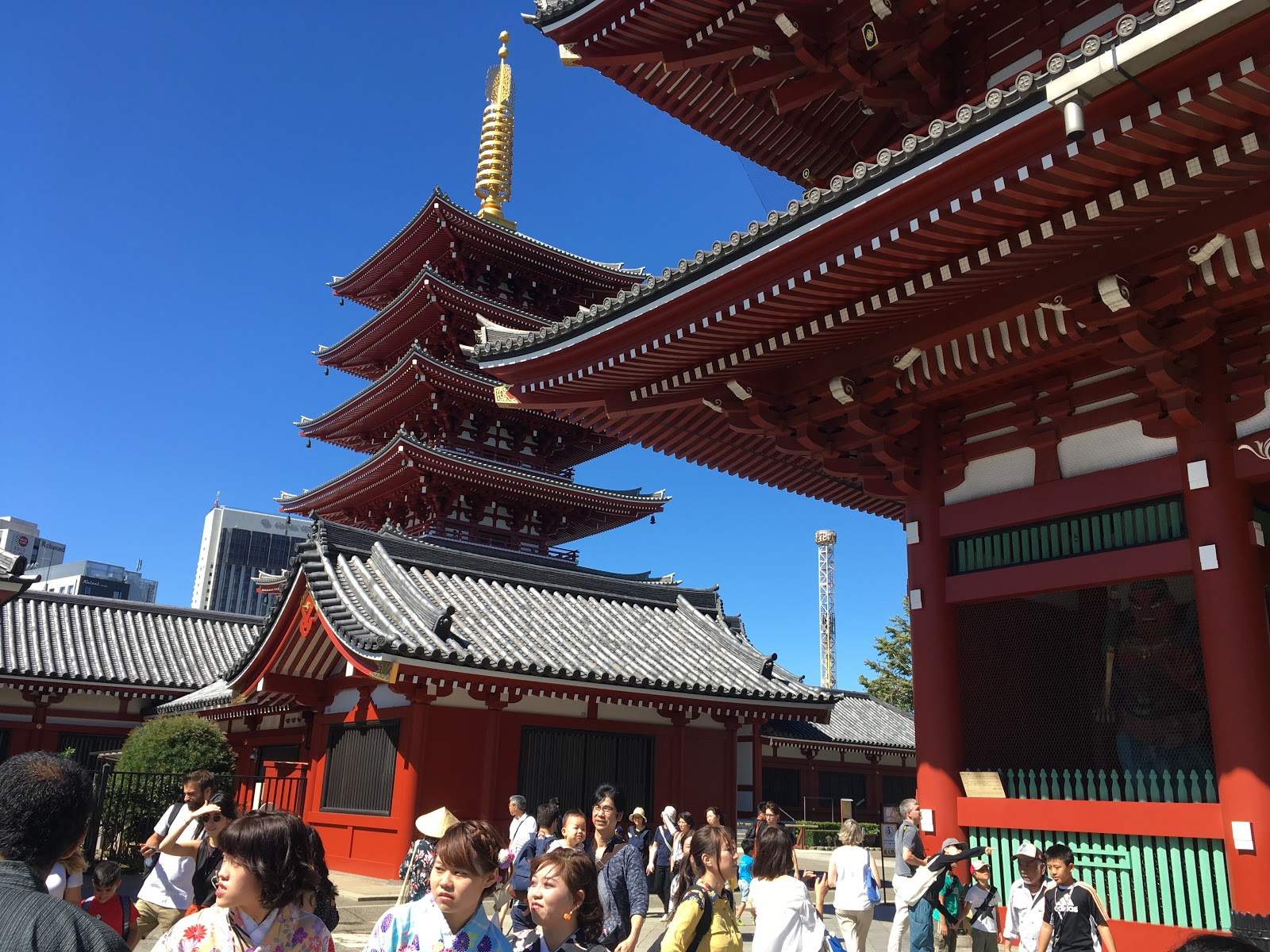
As I mentioned in a previous post, Tokyo is a very modern city, despite being very old, so I had to really look to find the historical stuff. Luckily for me, I found one of the best - Sensoji Temple!

Sensoji Temple was built to honor a Buddhist goddess of mercy, named Kannon. The story behind the temple is that two brothers were fishing in a nearby river, and they found a statue of the goddess. They tried to give it back, but the statue kept reappearing, so it was decided to build a temple there to honor the goddess.

The temple is the oldest one in Tokyo, going back to the 7th century (although, if I remember correctly, it needed to be reconstructed after WWII... but I'm honestly not sure about that). It's very colorful and very beautiful.

To get there, first you walk up a market street of hundreds of souvenir vendors. I remember reading that in days gone by, they would sell seasonal items that you need for a festival, but today, they sell a lot of souvenirs. I got a lot of Christmas presents at Sensoji!

Anyway, after the long row of vendors, there's the gate leading up to the temple grounds. Hanging in the middle of this gate is a giant red lantern with black Japanese writing on it (I think Kanji):


Here it is closer:


And, here's that lovely symbol that we all love to see:

Remember - this is a symbol of Buddhism. It's not Nazism.

Here's the relief on the bottom of the lantern. Isn't that beautiful?!

Take a nice step back and see the gate from a distance. 
A lot of these Asian temples have beautiful wood designs under the eaves:


I saw lots of people doing this pose. Gotta be a tourist!

Once you go up the row of vendors and go through the main gate, there's a huge square open area and across that is the shrine holding the goddess's statue (and a lot of gold ornaments to go with it). Inside the walls of the big square are rooms that you can look into but you can't go into; there are different kinds of smaller statues in those rooms, which you can see, but I didn't get pictures of them.

The next pictures are from the square area, leading up to the main shrine.

Another lantern hanging in a doorway, but I didn't go through that one. 

A pagoda

If I remember correctly, this was the building where you could buy your fortune. Do you see the wooden frame in the background with white paper tied to the strings going between it? See this post if you don't remember what that's from. 


Here's part of the garden

This is the pathway going up to the main temple. The right and left are stalls that sell spiritual items like fortunes and amulets.

This is where people wash their hands to be pure for the temple

The entrance to the main temple. Notice another lantern!

The next pictures are from the inside of the main shrine. These next pictures, I got mostly for the beautiful artwork.

I assume this is Kannon, the goddess whose statue washed up in the river. 

A dragon, holding a pearl... I honestly don't know, but does this have anything to do with The Librarians episode?


Inside the temple. They asked for no pictures of the goddess's statue, so I just have pictures like this.  

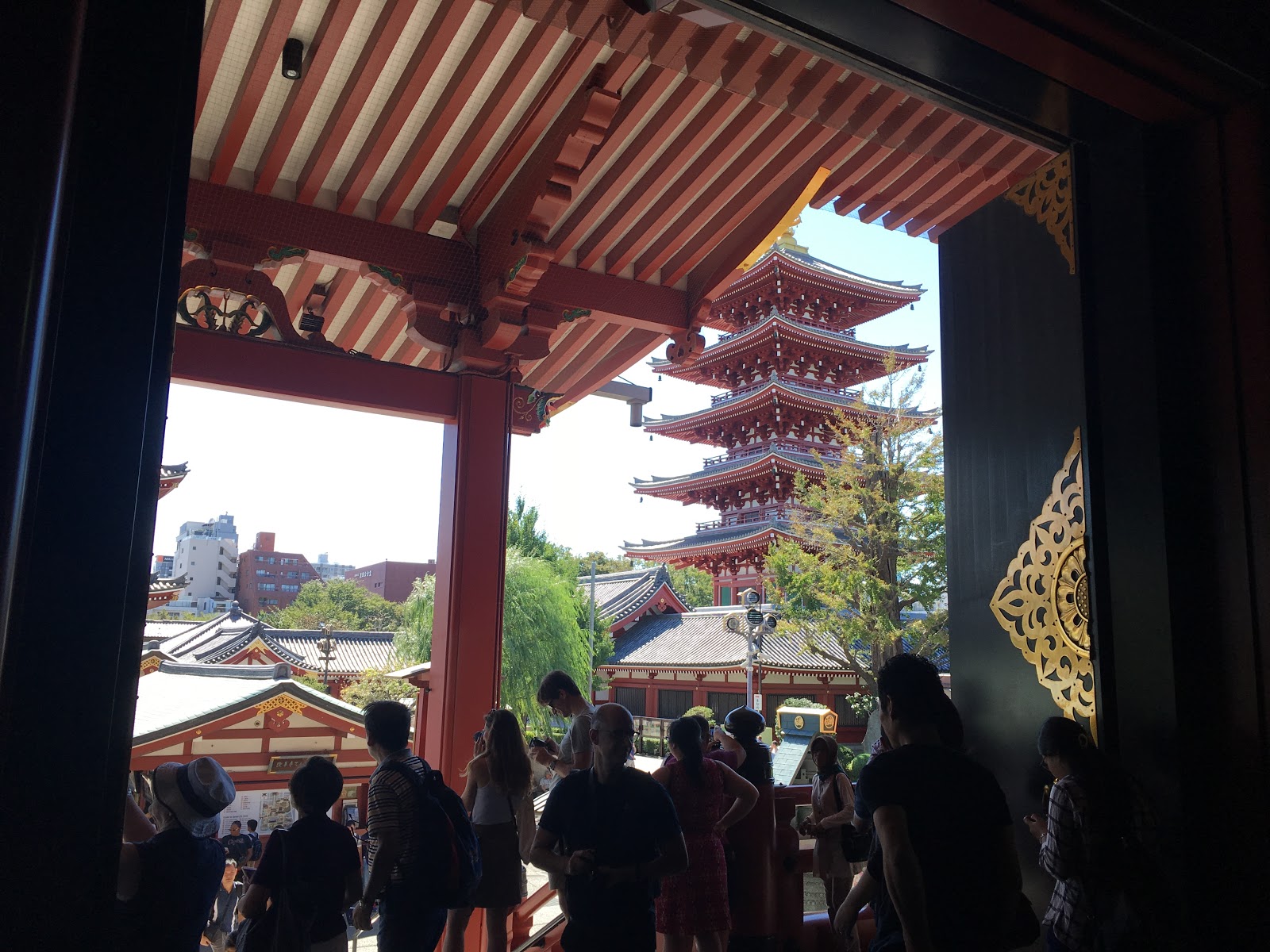
Looking back at the square area from the top of the main shrine. 


After that, I wandered around the square and took pictures of the sides:


One of the shrines in the walls.


Something I noticed is that it's not unusual at all to see people in kimonos. I especially saw a lot of them at the shrines, where I assume they were either there for a formal occasion, or they were tourists doing the various kimono tours:


Anyway, that was the oldest shrine in Japan. I spent a lot of time staring at the artwork, which is almost totally new to me. After this shrine, I joined forces with my dear, sweet, adorable, interminably patient roommate, and we toured the rest of Tokyo and part of Kyoto together. Day 3 is going to have a huge post, to say nothing of Kyoto, which will be insane. I'm planning to get to all of that during the rest of this break, but then, that's what I said for the last two breaks, so... who knows. 

Anyway, stay tuned!

Friday, April 5, 2019

Ueno Park - Zoo and the Typhoon

About the time I was in Japan, we heard about a horrible typhoon farther south, towards Hong Kong. I didn't know much about it, and since I didn’t sleep much on the trip from Nara to Tokyo, I was really too tired to think properly.

But, short version, there was a typhoon heading north as well, and the very edge of it brushed over Ueno while I was there.

But this all happened while I was in the Ueno Zoo. This is the oldest zoo in Japan, and somehow it survived WWII. Currently, its most popular attraction is the Chinese panda:


Not that there aren't other adorable animals too...

It's Anamay!
Anyway, it had been drizzling periodically all day, so I was't overly concerned with the fact that it was raining a little harder. My shoes were getting damp, but I had a raincoat-type thing, so I wasn't overly worried.


But right when I was going past the otters, the floodgates of heaven suddenly opened. In the blink of an eye, it went from fairly damp to everything soaking. It cut right through my coat, and my shoes, and soaked all my paper maps (not my phone, thankfully). 

I dashed inside the nearest building, the night exhibit, and hung out there to wait out the downpour. It was over surprisingly quickly, so I snuck out and tried to keep walking. Of course, by this point, I was completely drenched and getting a little chilly. I still stuck it out in the zoo until it closed, and by this point, I was just happy to hop on the subway and get back to my hostel to relax. 

When I got back, I saw the weather channel playing in the common room, and on the map, they showed the corner of a typhoon passing over Tokyo. 

So yes, I was stuck in a typhoon. 

I went out to dinner and came back, and no sooner did I get inside than I heard the sound of really loud rain pelting down. The typhoon was back! I stayed inside my capsule and did as much writing as I could, and the entire time, I listened to the sound of the typhoon outside. It was, to put it mildly, very windy. 

So, that was my first typhoon! Ah, good times.